By Dr Sangeeta Mittal
Birthbabe’s Yoga Therapy Columnist & Medical Editor
You are not a post-operative patient. You are a person doing profound healing work. Most of it invisible.
Most women leaving hospital after a C-section are handed a discharge sheet. It covers the basics – keep the wound clean, take pain relief, watch for signs of infection. What it almost never covers is what’s actually happening inside your body. Or why, weeks and months later, things can still feel deeply, strangely wrong.
Dr Sangeeta Mittal knows this better than most. As a former NHS obstetrician, she performed hundreds of C-sections. As a mother who has had an emergency C-section herself, she has lived the recovery. And as the founder of The London Yoga Therapy Centre, she has spent years helping women understand – and heal from – what surgery actually does to the body.
“Whether planned or an emergency,” she says, “a C-section is a major abdominal surgery that a woman’s body holds in layers.” Dr Mittal shares below what your surgeon may not have.
Seven layers opened. Seven layers healing.
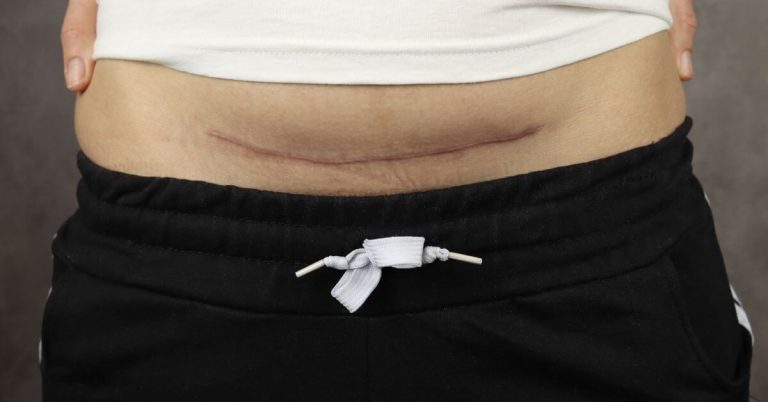
When most women are told they’re having a “bikini-line cut,” what they’re actually undergoing is a profound reorganisation of seven distinct layers of the body: skin, subcutaneous fat, fascia, the rectus abdominis, the peritoneum, the bladder flap, and the uterus.
NICE guidelines and clinical protocols focus on what happens immediately after surgery – infection monitoring, wound breakdown. What is rarely discussed at the six-week check is the long-term impact on the body’s internal architecture.
That impact is significant – and it starts with adhesions.
The secret life of adhesions
As the seven layers heal, they should ideally slide and glide independently. In many cases, scar tissue acts differently. It can behave like internal glue, binding layers together that were never meant to be bound.
This is not rare. This is common. And the consequences reach further than most women are told.
Adhesions can cause a sudden urge to urinate, because the uterus has become physically tethered to the bladder. They can affect posture, movement, and the way internal organs function. They can restrict deep belly breathing, inadvertently keeping the nervous system in a low, constant state of alert.
There are physical effects that many women are never warned about.
And the gap, the absence of real community, compounded by the impossible pressures on our healthcare providers, may be part of the reason why so many women feel so alone and ill-informed.
Why your core feels like it’s gone offline
After a C-section, many women try to “engage their core” and find that nothing happens. They’re often told to try harder. What’s actually happening is more complex – and more forgivable.
During surgery, small surface nerves are disrupted. The brain receives conflicting signals and, in response, often quietens the entire area. This is what I call nerve amnesia.
The body, in its attempt to protect itself, temporarily reduces communication with the affected area. It is not weakness. It is adaptation.
The brain is essentially muting the core to protect a site of significant injury.
So when traditional advice tells you to strengthen and tone and “get your core back” – and it feels not just frustrating but impossible – that’s because it is. You can’t strengthen a connection that hasn’t been re-established yet.
You don’t need strengthening first. You need reconnection.
The shelf, the stoop, and the breathing change
Three physical patterns show up repeatedly in women post-C-section, and all three are connected.
The shelf
This is the fold of skin that can appear above the scar. It is not always about fat.
More often, it is about tension beneath the surface. When deeper layers of tissue are restricted and pull inward, the tissue above sits differently. The shelf is a symptom of what’s happening internally, not just aesthetically.
The stoop
The stoop is the instinctive forward curl many women develop in the days after surgery, guarding the incision. It’s a deeply human reflex. But if the body stays there, the tissues begin to adapt – leading to longer-term tension in the neck, shoulders and back.
Breathing
The breathing change is perhaps the least visible and the most consequential. The fascia of the lower abdomen connects in a continuous chain all the way to the diaphragm.
When a scar feels tight, breathing deeply into the belly can feel uncomfortable or even unsafe. So the body adapts. Many women begin breathing into the chest instead, often without realising it.
Over time, this can keep the nervous system in a low, constant state of fight or flight.
Your body is in protection mode
After birth – and particularly if birth felt sudden, frightening, or out of control – the body may remain in a protective state long after the incision has healed. The nervous system is still holding the memory of the event.
The physical and the emotional are not separate. They move together, shaping how the body holds, heals and remembers.
This is why healing a C-section scar is not just a physical process – it is a neurological one and an emotional one.
In the early weeks: trust the breath
At The London Yoga Therapy Centre, the first phase of C-section recovery is almost entirely breath and rest. No intense movement, no pressure to bounce back. Just a quiet reintroduction of awareness.
I being with something I call the “side-rib breath”. Rather than asking the body to breathe into the belly – which can feel vulnerable and unsafe – the focus is on the outer ribs.
Hands rest gently beneath the bust, the breath expands outward like an accordion. The inhale creates space. The exhale softens.
Over time, the body begins to trust that it is safe to expand again.
As soon as it feels possible – without force – I introduce a simple posture called the Mountain Heart: a gentle lifting through the collarbones for just a few breaths, to begin counteracting the protective curl. Small, meaningful shifts.
Reconnecting within
Before there can be strength, there must be connection. I like to describes the reconnection phase as a software update – the body re-mapping the area, restoring communication between brain and muscle, sensation and response.
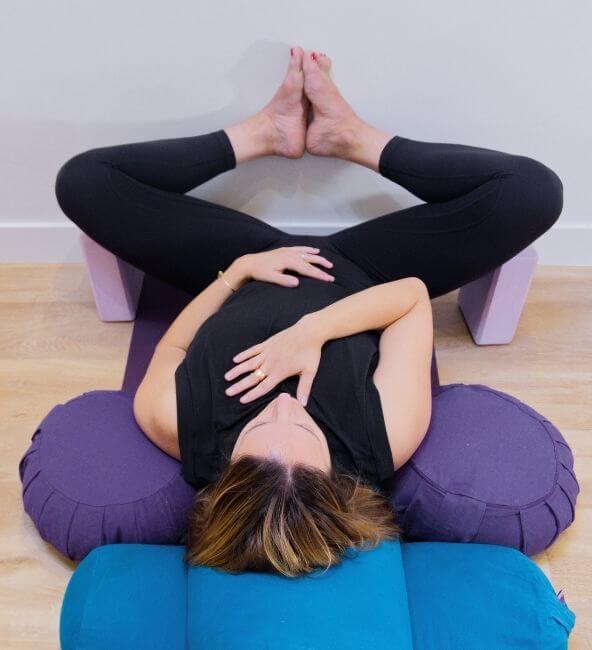
Sometimes it begins with something as simple as placing one hand on the heart and one just above the scar. Not pressing, not fixing, just noticing. Warmth, numbness, sensation – or perhaps the absence of it.
Over time, that quiet attention begins to bring the area back into awareness. And with that awareness can come emotion, such as grief, anger, relief, even unexpected tears. This is not a problem. It is the nervous system beginning to thaw.
The Internal Tug Sequence
Once the breath has done its quieter work and the incision is fully closed, we then start to focus on the Internal Tug Sequence – three simple movements designed to work at different depths within the body. The goal is not to return to who you were before. It is to feel at home in your body again.
The Supine Windshield Wiper
This moves the skin and muscle layers in opposite directions to break up surface-level stickiness.
Lie on your back, knees bent, feet flat and wider than your hips.
Slowly drop your knees to one side while turning your head the other way and sliding your opposite arm along the floor above your head.
You should feel a long, diagonal pull from your hip bone toward your ribs.
Breathe into the pull.
The Pelvic Clock
This helps unstick the bladder and uterus from the abdominal wall.
Lie on your back, knees bent.
Imagine a clock face on your lower belly – 12 is your navel, 6 is your pubic bone.
Use tiny, microscopic movements to tilt your pelvis toward 12, then 6, then side to side.
This isn’t a workout. It’s a mechanical wiggle for your internal organs.
The Modified Sphinx
This addresses the protective stoop many women develop.
Lie on your belly if comfortable, or lean against a high surface.
Prop yourself on your elbows, chin tucked slightly.
Feel the front of your belly lengthen.
If it feels like ripping, ease back until it feels like a gentle yawn in the skin.
If you feel a sharp, hot, or electric sensation during any movement, that is a nerve signal saying too much, too fast. Ease back.
In yoga therapy, the aim is a dull, broad, or warm sensation – which indicates the fascia is safely rearranging itself.
You are not a post-operative patient
This is perhaps the most important thing women must know.
You are not a post-operative patient. You are a person doing profound healing work. Most of it invisible.
For too long, C-section recovery has been treated as something to get through. A wound to close. A box to tick at six weeks.
A different approach is to know that real recovery – the kind that restores not just function but confidence, connection, and a sense of being at home in your own body – is possible. It just requires the right information, the right support, and the understanding that your body is not broken.
It is healing. And it deserves to be met with the same care and attention as any other profound experience of your life.
Dr Sangeeta Mittal is the founder of The London Yoga Therapy Centre, offering trauma-informed therapeutic yoga for fertility, pregnancy, birth and postnatal recovery. Learn more at lytcentre.org
If you are currently struggling with your C-section recovery – physically or emotionally – please speak to your GP, midwife or health visitor.
Feature image: Supplied | London Yoga Therapy Centre
Birthbabe is supported by the beautiful babes who enjoy our content. We only recommend products we genuinely rate. We may receive an affiliate commission.
Birthbabe does not provide medical advice, diagnosis, or treatment. The resources on our website are provided for informational purposes only. You should always consult with a healthcare professional regarding any medical diagnoses or treatment options.